Portes Strategy — Opening, Mid-Game & Endgame
Portes backgammon strategy guide: building points, anchors, primes, pip count, racing decisions, and bearing-off technique for beginners and intermediates.
Play now PortesPortes backgammon strategy guide: building points, anchors, primes, pip count, racing decisions, and bearing-off technique for beginners and intermediates.
Play now PortesNot all closed points are equally valuable. Your 5-point is the strongest on the board because it simultaneously protects the bear-off area, blocks re-entry from the bar, and restricts the opponent's movement.
Next in value come the 4-point and the bar point (7-point). The bar point is precious because it traps the opponent when they re-enter from the bar. Conversely, the 1-point and 2-point are rarely worth heavy investment early, since they mainly block your own checkers.
In the opening, prefer moves that make points on the 5, 4, and 7 over moves that simply race checkers forward without support.
Opening rolls set the structure for the whole game. There is no single "right" move for every roll, but experienced players follow well-known principles.
6-5 (Lover's Leap): move a checker from the 24-point to the 13-point. No contact, but a strong running move. 6-4: move from 24→18 and 13→7, or 24→18 and 8→4. Goal: make the bar point or unstick back checkers. 3-1 is the best opening roll: you make your 5-point (8→5 and 6→5) and immediately hold three points, the 6, the 5 and the 8.
4-2: make your 4-point (8→4 and 6→4). Excellent. 6-1: make the bar point (13→7 and 8→7), a strong result. 5-3: make the 3-point (8→3 and 6→3). Decent, though the 3-point is less critical. 2-1 is one of the awkward rolls: move 13→11 or 6→5 and 24→23, prioritising development.
An anchor is a closed point in the opponent's home board, typically the 20-, 21- or 22-point. An anchor gives you three things: a safe re-entry point if you get hit, a threat to hit the opponent, and disruption to their movement.
The best anchor is on the 20-point (opponent's 5-point). If you have it, the opponent is forced to play very carefully. The 21- and 22-points are also strong. Holding only the 24-point, on the other hand, achieves very little.
When to abandon the anchor? When the opponent has so many closed points in their home board that you can't escape anyway, or when the race count is clearly in your favour.
A blot is not always a mistake. Many excellent moves leave temporary risk. The problem is leaving multiple blots simultaneously or leaving them where the opponent can hit easily.
Direct range is 1–6 points away: high risk, because a single die can hit you. Indirect range is 7–12 points away, where the opponent needs a specific combination. Beyond 12 points, the risk drops significantly.
A useful rule: if the opponent has more than 12 direct shots (out of 36 possible rolls) that can hit you, the position is dangerous. Fewer than 6 direct shots is acceptable risk for a good move.
A prime is a sequence of consecutive closed points. A 6-prime is an absolute prison: if the opponent has checkers behind it, no dice roll can escape.
In practical play, a 4-prime or 5-prime is often enough to decide the game. To build a prime you need checkers in the right positions to fill the gaps. Plan ahead: see which points are missing and keep checkers nearby.
A prime also needs defending: if you leave open gaps between closed points, the opponent can slip through. Keep 2 checkers on each prime point and use spare checkers to extend it forward or backward.
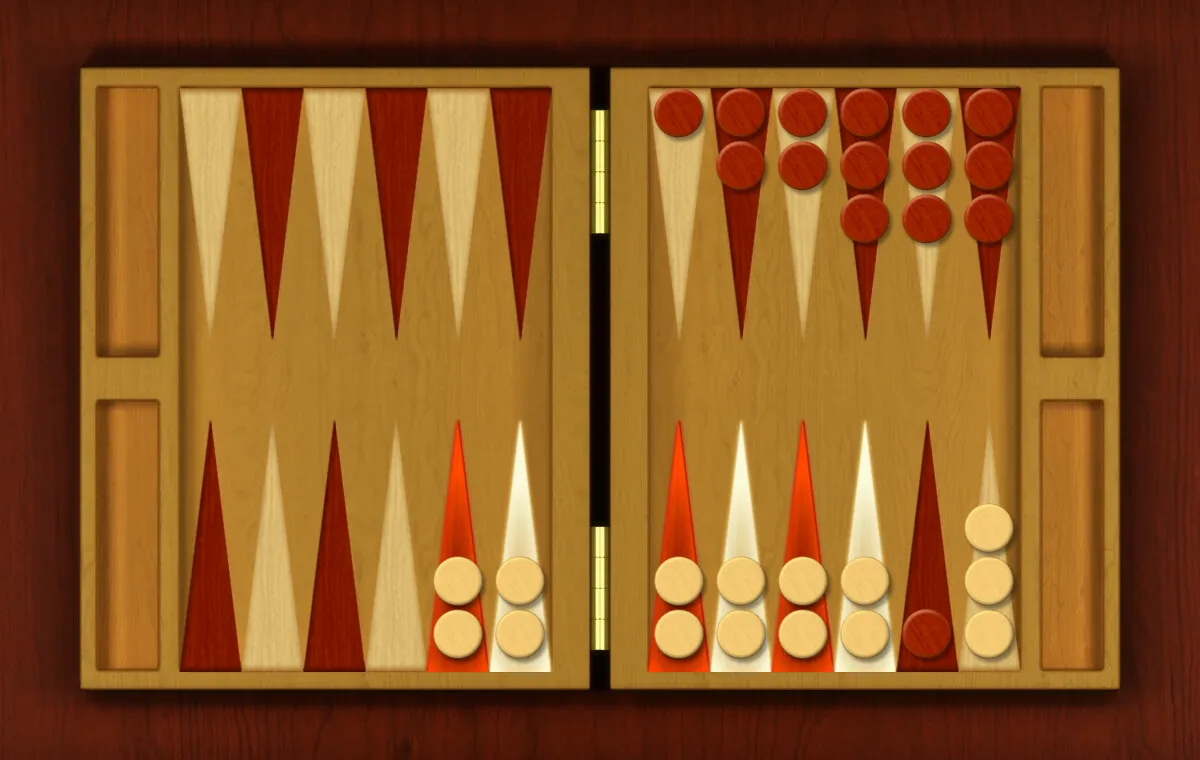
The pip count is the total number of points all your checkers need to travel to be borne off. If your pip count is lower, you are ahead in the race.
You don't need an exact count in every game. A rough estimate is enough: if most of your checkers are already halfway around while the opponent still has many back, you're ahead. If you have 2–3 checkers on points 20–24 while the opponent has none, you're behind.
The pip count changes your strategy: if you are clearly ahead, play defensively and avoid contact. If you are behind, play aggressively and look for chances to hit or create obstacles.
The most common strategic mistake beginners make is breaking a strong position by racing checkers forward while the opponent still holds a back anchor.
Stay in contact (don't run) when: the opponent has checkers in your home board threatening, you have a prime or good position, and you have no significant race lead. Race when: you are clearly ahead in the pip count, you have no way to improve your position, and the opponent cannot create obstacles.
The transition from contact play to a race is one of the hardest decisions in Portes. General rule: race only when you have at least a 10–15 pip lead, not counting potential rolls.
Many games are won or lost in the bear-off, not the mid-game. The core principle is to keep checkers evenly distributed across points 1–6, so every die removes a checker.
The worst formation is a pile of checkers stacked on the 6-point while points 1–4 are empty: every 1, 2, 3 or 4 then becomes a wasted roll. Spread your checkers instead, aiming for 2–3 per point.
If the dice force you to bear off from a point with no checker, you bear off from the next highest occupied point. If you roll a 6 but have no checker on the 6-point and have one on the 5-point, it bears off from there. This rule often surprises new players.
On doubles you play the same number four times. That means you can build two points in one turn, escape a difficult position, close your home board, or bear off 4 checkers at once.
Don't play doubles in a hurry. Because they are your most powerful rolls, they deserve extra thought. The most common trap is automatically advancing checkers with 6-6 when the better use would be building your home board or hitting.
Remember: doubles appear 6 times in 36 possible rolls, roughly once every 6 turns. Design your strategy knowing the opponent will likely roll doubles once per 6 turns. Can you survive a 6-6 without losing your position?
The 3-1 is widely considered the best opening roll because it lets you immediately make the 5-point (8→5 and 6→5), the strongest point on the board.
The pip count is the total number of points your checkers still need to travel to bear off. Count how far each checker is from position 0 (off the board). If your total is lower than the opponent's, you are ahead in the race.
Hitting is worth it when the point you land on is important (e.g. 5-point, bar point), or when you send the opponent into a closed home board. Avoid hits that leave you exposed without meaningful impact.
Build a prime gradually: make 3–4 consecutive points first and keep checkers near the gaps. The goal is to have opponent checkers trapped behind the wall while you extend forward.
The player with the lower pip count wins, meaning the one whose checkers are closer to being borne off. Distribution in the home board also matters: an even spread bears off faster than stacks.
Try what you just read in a real game, solo or online with a friend, straight in your browser.
Start a gameWant the full picture first? The Portes tavli page has rules, strategy and FAQ in one place. Or play tavli online in any variant you prefer.