Play Plakoto Tavli Online Free
Want a human opponent?
We'll find someone, or send a friend the link.
Play Online
Looking for an opponent…
Νo one is around right now. Keep waiting — or play the AI and try again later.
Play Plakoto tavli online free
On Tavli.net you play Plakoto tavli instantly in the browser — against the computer, a friend via a room link, or anyone from the queue. No registration, no app download.
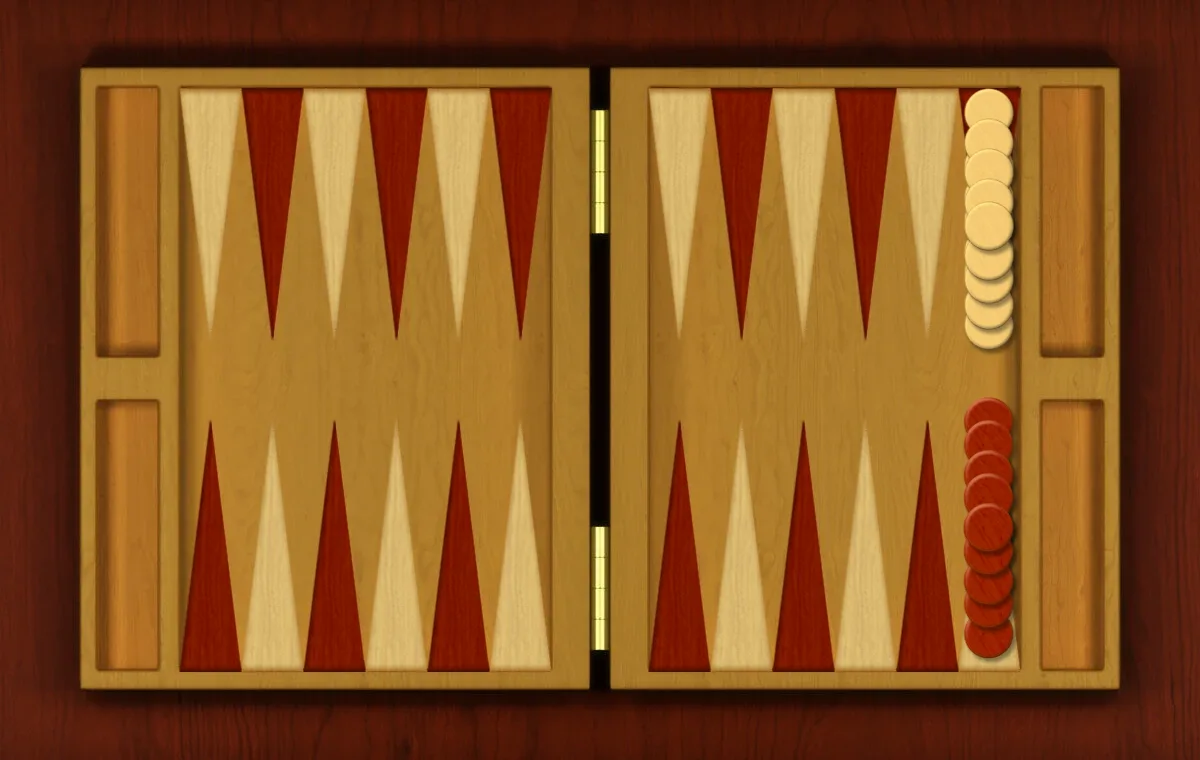
All checkers start from the opponent's home point. You pin instead of hit. The board is already above: pick an opponent and start.
Plakoto tavli setup: the starting position
In Plakoto there is no spreading. Each player starts with all 15 checkers stacked on the 24-point — the opponent’s home point — so the two stacks sit on opposite corners of the board. You move counter-clockwise toward your own home board.
The last checker left behind on the starting point is the mother checker. While it stands alone the opponent can pin it and win the game on the spot — so Plakoto’s setup is simple, but your first concern is always when and how to bring the mother out.
Want all three variants side by side? The tavli board setup guide shows Portes, Plakoto and Fevga with diagrams.
What is Plakoto?
Plakoto is one of the three core variants played in Greece as part of the traditional "trio" (Portes – Plakoto – Fevga). It differs fundamentally from Portes because there is no bar: your checker traps the opponent in place, making it a more tactical game that rewards careful defensive thinking.
Plakoto is believed to have developed in Asia Minor and the Eastern Mediterranean, alongside related variants still played today in Turkey (Tapa) and the Middle East. It arrived in Greece with the 1922 refugees and quickly became established as the second game of the trio.
Its defensive style and the tension around the home point (where a single pin can mean an instant loss) have made it a favourite among experienced players who want less of the luck element present in Portes.
Plakoto Rules
- All 15 checkers per player start stacked on the 24-point (the opponent's home point).
- You move toward your own home board and then bear off, just like in Portes.
- Instead of hitting blots, you pin them: your checker sits on top and the opponent's checker cannot move.
- A pinned checker is freed only when you move your checker off that point.
- There is no bar: checkers never re-enter from the start.
- If you pin your opponent's home point (their starting point), they lose immediately. This is called a closed gate or gammon.
- Doubles are played four times, as in Portes.
- Once all 15 of your checkers are in your home board, you start bearing off.
- The winner is the first player to bear off all 15 checkers.
Want the rules with diagrams and step-by-step examples? Read the full Plakoto rules guide.
Plakoto Strategy
- Guard your home point: if you leave it unprotected and your opponent pins it, you lose immediately.
- Pin your opponent's checkers aggressively when they are in your area. Every pinned checker is one fewer that can block your bear-off.
- Use doubles to create multiple pins in a single turn.
- Don't rush to move off points where you have pinned: as long as you stay, your opponent stays trapped.
- Play a racing game only when you are significantly ahead; otherwise keep pins to force the opponent to waste useful rolls.
- At the end, plan carefully which pin to release first. Sometimes it pays to wait so the opponent does not suddenly revive.
For in-depth strategy with plans for every game phase, see the Plakoto strategy guide.
Common Mistakes — Plakoto
- Leaving their home point (24-point) unguarded and losing immediately to a closed gate.
- Pinning without thinking about whether they can maintain the pressure. Releasing too early throws away the advantage.
- Playing as if it were Portes and trying to 'hit' instead of 'pin'.
- Neglecting defence and letting the opponent build walls in their area.
- Misreading their roll: in Plakoto, moving a checker off a point where you have a pin frees the opponent.
Glossary — Plakoto
| Term | Definition |
|---|---|
| Pin | When you place your checker on top of a lone opponent checker, trapping it in place. |
| Closed gate | When you pin your opponent's starting point (24-point), you win immediately. |
| Gammon | Double victory: you finish before the opponent bears off any checker, or their home point is still pinned. |
| Pinning checker | The checker doing the pinning; you cannot move it backwards to release the opponent. |
| Pinned | An opponent's checker that has been pinned and cannot move. |
| Point | A spike with 2+ of your checkers; the opponent cannot land here. |
| Doubles | Same numbers on both dice; played four times. |
| Bearing off | The phase where you remove your checkers from the board once they have all reached your home board. |
Plakoto: How It Differs from the Other Variants
Unlike Portes, in Plakoto there is no bar and nobody loses a turn. Instead, the game is 'closed': a single checker of yours can immobilise the opponent's for many turns.
Compared with Fevga, Plakoto is more directly aggressive: you interact constantly with the opponent's checkers. In Fevga you simply cannot pass where they stand.
FAQ — Plakoto
Where can I play Plakoto tavli online free?
Right here on Tavli.net. Play Plakoto tavli online free against the computer, a friend via a room link, or anyone from the queue — no registration. The board is at the top of this page.
What does "gammon" mean in Plakoto?
When you bear off all 15 checkers while your opponent has not borne off any, or their home point is still pinned, you win a double victory.
Is it the same as Portes?
No. In Plakoto checkers are never hit. All strategy revolves around pinning the opponent at the right points.
Is it played together with Portes and Fevga?
Yes. Traditionally played as a trio: whoever wins 5 games first takes the overall match.
What happens if all my checkers are pinned?
You don't lose immediately, but you're in a very difficult position. You must wait for the opponent to move off the points where they have you pinned.
Can I bear off if I have a pinned checker?
No. All your checkers, free and pinned alike, must have reached the home board before you can start bearing off.
How do I avoid losing to a closed gate?
Always keep at least 2 checkers on your home point until you're sure the opponent cannot pin it.
How long does a game of Plakoto take?
Usually 10–20 minutes, slightly longer than Portes because of the pinning mechanics.
Other Variants Beyond Plakoto
- Portes tavli — The classic tavli variant — Greek backgammon as played in every kafeneio.
- Fevga tavli — No hitting. All checkers move in the same direction.
New to tavli? Start with the beginner's guide, which covers the basics of all three variants. Or head back and play tavli online in any variant you like.