Play Fevga Tavli Online Free
Want a human opponent?
We'll find someone, or send a friend the link.
Play Online
Looking for an opponent…
Νo one is around right now. Keep waiting — or play the AI and try again later.
Play Fevga tavli online free
On Tavli.net you play Fevga tavli instantly in the browser — against the computer, a friend via a room link, or anyone from the queue. No registration, no app download.
No hitting or pinning. You simply cannot pass through any point the opponent occupies. The board is already above: pick an opponent and start.
Fevga tavli setup: the starting position
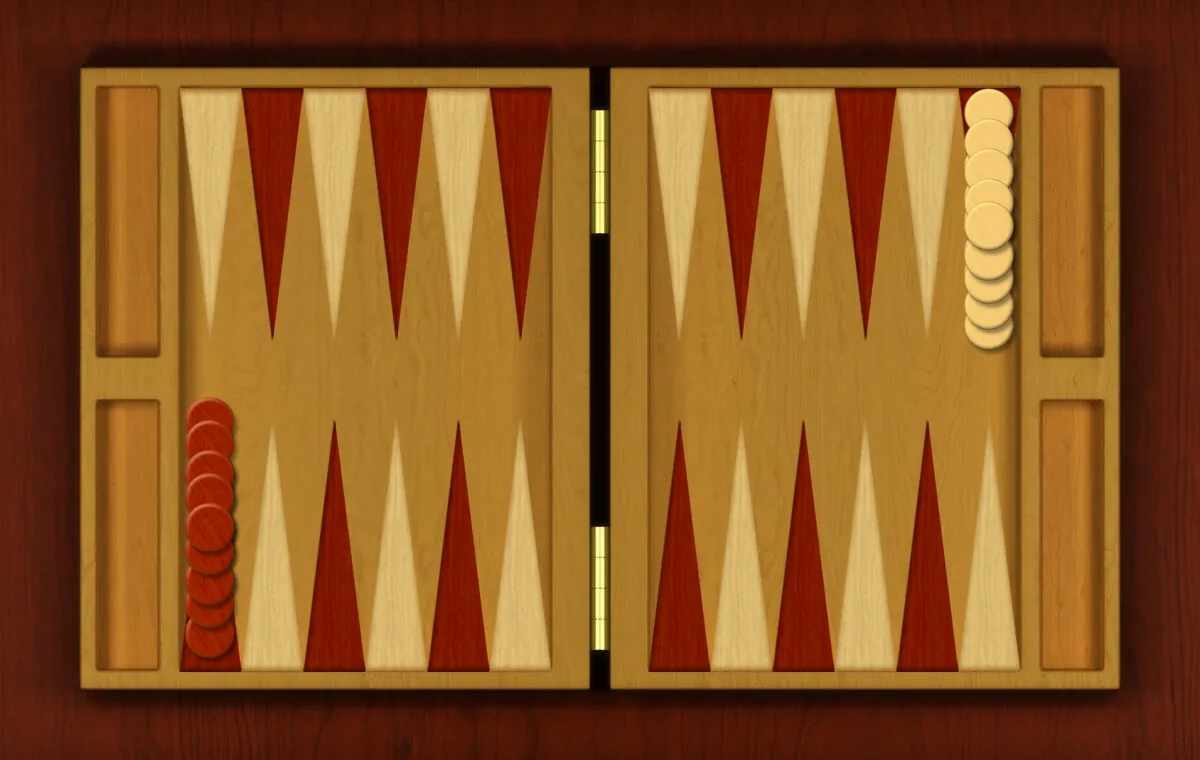
Fevga sets up like Plakoto — all 15 of each player’s checkers in one stack — but the two stacks are not face to face: white starts top-right and red bottom-left, on the diagonal. Both players move in the same direction, counter-clockwise.
Because one side chases the other around the board, there is no head-on contact: no hitting, no pinning. Your first checker must advance into the opponent’s area before you move any other — that rule is what gives the Fevga opening its character.
Want all three variants side by side? The tavli board setup guide shows Portes, Plakoto and Fevga with diagrams.
What is Fevga?
Fevga is the most tactical and "pure" of the three variants. Because there is no hitting or pinning, it relies entirely on positioning and building walls (primes).
It is essentially the Greek version of the Turkish Moultezim and is related to several Balkan variants. It arrived in Greece from Asia Minor and Smyrna, spreading as the "third" part of the traditional series to balance the luck element of Portes and the aggression of Plakoto.
Fevga is a favourite among experienced players because luck matters far less than in the other two variants. Over a large sample of games the better player almost always wins. That is exactly why it is also known as the 'game of the expert'.
Fevga Rules
- All 15 checkers per player start at the same end: white on the 24-point, black on the 12-point.
- Both players move in the same direction (counter-clockwise).
- There is no hitting or pinning: no interaction between checkers of different players.
- You cannot land on any point that has even one of your opponent's checkers.
- You cannot place more than 1 checker on the opponent's first 6 points until you have passed through them yourself.
- Doubles are played four times, as in the other variants.
- Once all 15 of your checkers reach your home board, you start bearing off.
- The winner is the first player to bear off all their checkers.
Want the rules with diagrams and step-by-step examples? Read the full Fevga rules guide.
Fevga Strategy
- Build a prime of 6 consecutive closed points in front of your opponent to trap them behind you.
- Don't advance checkers in isolation. Your power is in moving as a unit.
- Watch the '1 checker maximum' restriction on the opponent's first 6 points until you have passed through yourself.
- During the bear-off, don't leave checkers behind if the opponent still has a prime: they can block you.
- Play patiently: since you can't hit, the only way to win is through speed and precise positioning.
- When pip counts are equal, whoever holds the better prime usually wins.
For in-depth strategy with plans for every game phase, see the Fevga strategy guide.
Common Mistakes — Fevga
- Trying to 'hit', when there is no hitting in Fevga.
- Wasting a roll on points occupied by the opponent and forfeiting the move.
- Violating the '1 checker' rule in the opponent's first 6 points without noticing.
- Racing to bear off without stabilising their last checkers.
- Ignoring the patience the game demands and looking for aggressive moves that don't exist.
Glossary — Fevga
| Term | Definition |
|---|---|
| Prime | Consecutive closed points. The longer it is, the harder it is for the opponent to pass. |
| Closed point | A point with 2+ of your checkers. The opponent cannot land there. |
| Rule of 1 | You cannot place more than one checker on the opponent's first 6 points until you have passed through them yourself. |
| Doubles | Same numbers on both dice; played four times. |
| Bearing off | The phase where you remove your checkers from the board. |
| Expert's game | A popular expression for Fevga, because the more thoughtful player almost always wins. |
Fevga: How It Differs from the Other Variants
Compared with Portes, Fevga is the exact opposite: zero contact with the opponent's checkers, no ability to send them back. All strategy is positional, not aggressive.
Compared with Plakoto, Fevga doesn't trap: if the opponent has a checker on a point, you simply cannot land there. Luck counts for less, thinking for more.
FAQ — Fevga
Where can I play Fevga tavli online free?
Right here on Tavli.net. Play Fevga tavli online free against the computer, a friend via a room link, or anyone from the queue — no registration. The board is at the top of this page.
Why is it called Fevga?
The name means 'flee' in Greek: all checkers simply race toward the far end of the board with no hitting.
Is it the same as Moultezim?
Yes, Fevga is the Greek version of the Turkish Moultezim and is related to several Balkan variants.
What is the "rule of 1"?
Until you have moved your own checkers past the opponent's first 6 points, you cannot leave more than one of your checkers on any of those points.
Is there a gammon in Fevga?
Yes. If you finish while the opponent has not borne off any checker, you win a double victory.
How long does a game of Fevga take?
Usually 15–25 minutes. It is the slowest of the three variants because there are no dramatic swings from hits.
Is it played internationally?
Yes, as "Moultezim" or under various Balkan names. It is not widely known in international online backgammon: it is mainly a Greek and Turkish tradition.
Why is it called the 'expert's game'?
Because the luck factor is smaller. If you know what you're doing, you will almost always beat a beginner, something that doesn't always happen in Portes.
Other Variants Beyond Fevga
- Portes tavli — The classic tavli variant — Greek backgammon as played in every kafeneio.
- Plakoto tavli — Pin your opponent's checkers. They can't move until you let them go.
New to tavli? Start with the beginner's guide, which covers the basics of all three variants. Or head back and play tavli online in any variant you like.