Fevga Tavli — Rules, Setup & Strategy
Complete Fevga tavli guide: board setup, first-checker rule, primes, the forbidden prime rule, and strategies to win.
Play now FevgaComplete Fevga tavli guide: board setup, first-checker rule, primes, the forbidden prime rule, and strategies to win.
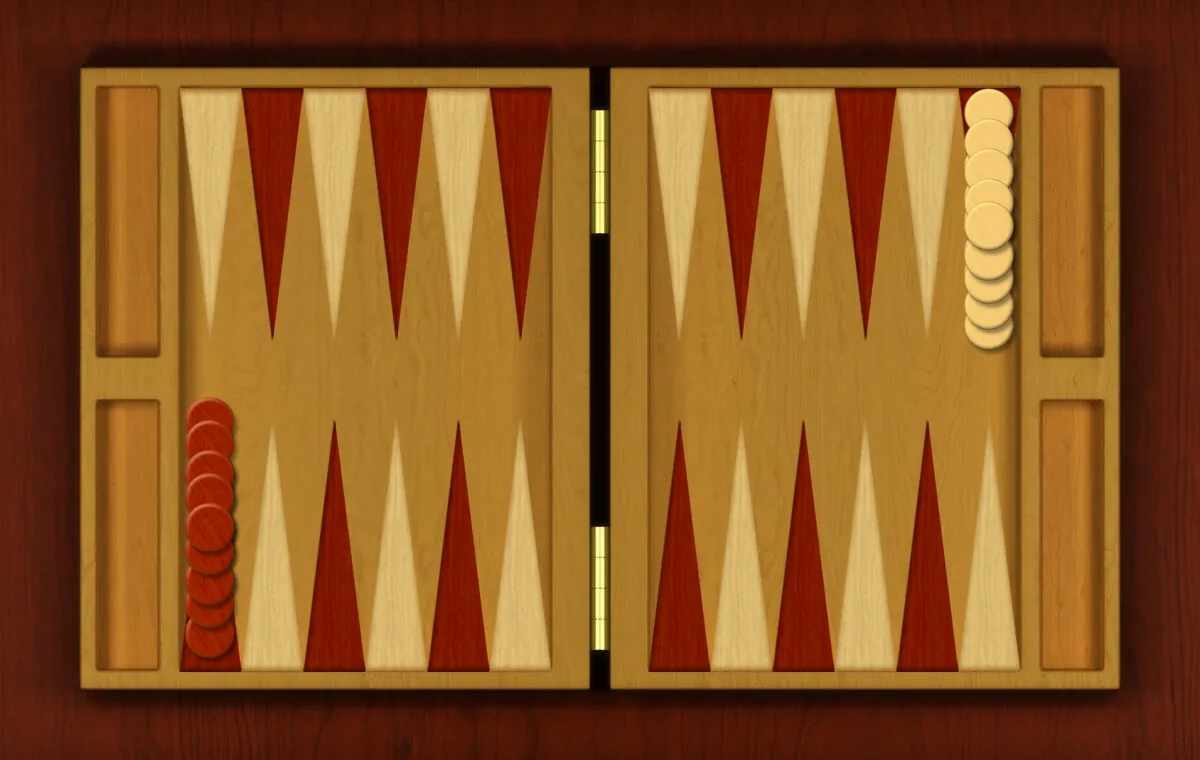
Play now FevgaThe Fevga setup is the simplest of the three variants: each player stacks all 15 checkers on their own starting point. White sets up top-right (their 1-point) and red bottom-left (their 1-point), diagonally opposite each other.
On Tavli.net the setup happens automatically when you start a Fevga game, but on a physical board it helps to know it: two stacks of 15 checkers on opposite corners, nothing else.
In Fevga both players move in the same direction around the board. There is no hitting, no bar, and no pinning.
The opponent cannot land on any point that has one of your checkers. The game becomes a race of positioning and space control.
At the start of Fevga you must advance one checker into the opponent's area before playing any other checker. Until then, all rolls are used on that first checker if possible.
This rule keeps the opening clean: first you get a checker into enemy territory, then you start spreading the initial stack.
Because there is no hitting, your main weapon in Fevga is the prime: consecutive closed points that the opponent cannot pass.
A long prime can pin the opponent for many turns. However, you may not close all 6 points in the opponent's starting quadrant; at least one must always remain open.
Fevga punishes impatience. You have no dramatic hits to turn the game around, so every misplaced checker stays on the board for a long time.
Play with a plan: keep a solid front, avoid stranding checkers at the back, and calculate when to open your prime.
Because of the first-checker rule, the opening in Fevga has a clear priority: move one checker into the opponent's area as quickly as possible. Once that checker is forward, you can freely develop the rest of your stack.
Once the first checker is unstuck, aim to spread your stack across different points. A cluster of 10+ checkers on one point moves very slowly. Distribute across 4–5 points to increase flexibility.
Try to reach points 7–12 quickly. From there you can start closing points ahead of the opponent and restricting their movement.
A prime in Fevga is powerful but also needs maintenance. If you run out of checkers to keep it intact, the wall will collapse on its own.
Signal to break the prime: when the opponent's trapped checkers are already too few to catch up even if freed, or when your pip count lead is so large that a freed opponent checker cannot reach you in time.
Don't break the prime just because you have no other move available. If you are forced to open it, break from the forward end, not the middle.
Fevga offers two main strategies: blocking (building a prime to immobilise the opponent) and racing (running without contact).
If you have many checkers forward but the opponent is close, blocking is your only option. If you have a 15+ pip lead, race and don't waste time building a prime.
The most dangerous situation: building a prime while the opponent slips past you. That's why you must always track where the opponent's checkers are. One checker that gets ahead of you in Fevga is very hard to catch.
Each player starts with all 15 checkers stacked on point 1. Both players move in the same direction, from point 1 toward point 24.
At the start of the game you must advance one checker into the opponent's area before you can play any other checker.
If you close all 6 consecutive points in the opponent's starting area they have no moves at all. The rule requires at least one point to remain open.
Try what you just read in a real game, solo or online with a friend, straight in your browser.
Start a gameWant the full picture first? The Fevga tavli page has rules, strategy and FAQ in one place. Or play tavli online in any variant you prefer.