Play Portes Tavli Online Free
Want a human opponent?
We'll find someone, or send a friend the link.
Play Online
Looking for an opponent…
Νo one is around right now. Keep waiting — or play the AI and try again later.
Play Portes tavli online free
On Tavli.net you play Portes tavli instantly in the browser — against the computer, a friend via a room link, or anyone from the queue. No registration, no app download.
Play with 15 checkers per player. Goal: bear them all off before your opponent. The board is already above: pick an opponent and start.
Portes tavli setup: the starting position
Portes is the only one of the three variants with a spread-out setup. Each player splits their 15 checkers across four points, mirroring the opponent, and the two sides move in opposite directions — which is why they meet in the middle and hitting exists.
The diagram shows the starting position exactly as Tavli.net sets it up. The two checkers on the 24-point are your back checkers, which must escape the opponent’s home board; the five on the 6-point and three on the 8-point are the material you build your own points with.
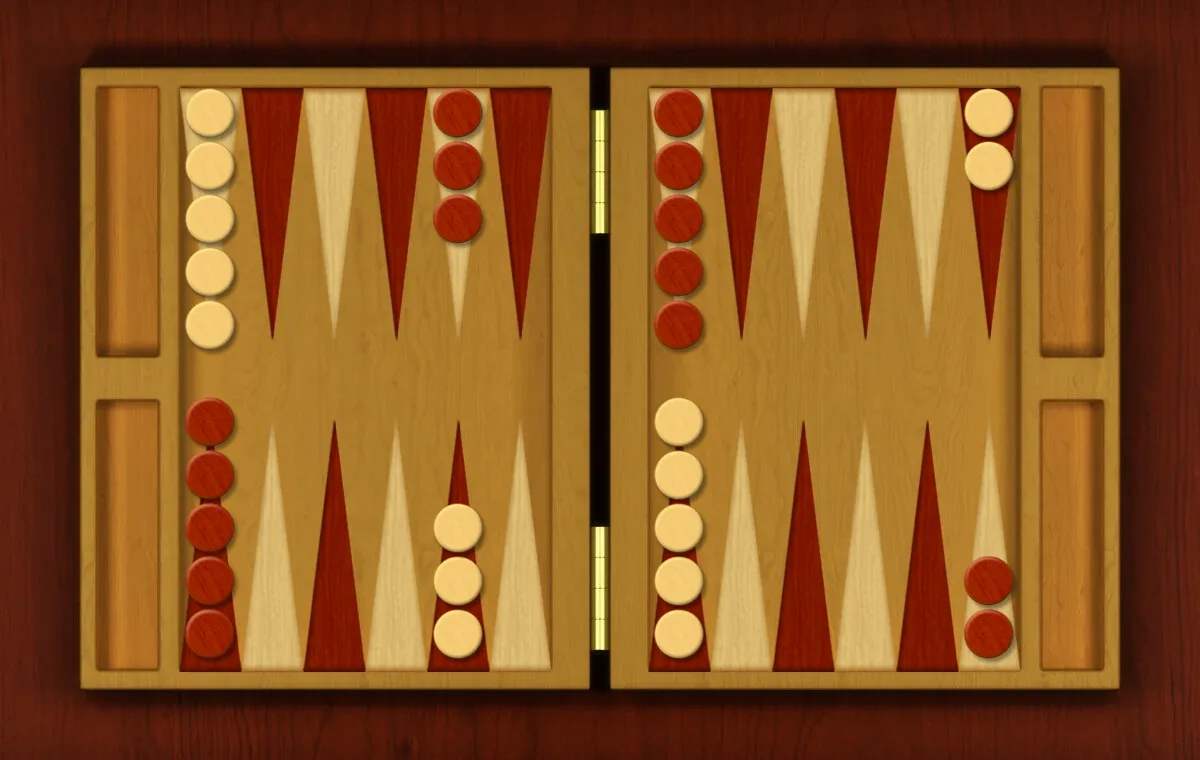
- 2 checkers on the 24-point — the farthest back, inside the opponent’s home board
- 5 checkers on the 13-point — the mid-point
- 3 checkers on the 8-point
- 5 checkers on the 6-point — inside your own home board
Want all three variants side by side? The tavli board setup guide shows Portes, Plakoto and Fevga with diagrams.
What is Portes?
Portes is the Greek name for classic backgammon, the same game played worldwide under the name "backgammon". It is by far the most popular of the three Greek tavli variants, and the one almost every child in Greece learns first.
The game's roots go back thousands of years to ancient Mesopotamia and Egypt. The Romans played it as ludus duodecim scriptorum; through the Byzantine Empire it spread across the Eastern Mediterranean, and in Greece it evolved into the form we know today, becoming an inseparable part of kafeneio (coffee shop) culture.
Today Portes is played internationally as backgammon in professional tournaments, with the World Backgammon Federation (WBF) hosting the annual World Championship in Monaco. In Greece it remains the most popular strategy game, with a thriving community for both live and online play.
Portes Rules
- Each player has 15 checkers in the classic starting position: 2 on the 24-point, 5 on the 13-point, 3 on the 8-point, and 5 on the 6-point.
- Roll two dice and move checkers the corresponding number of points toward your home board.
- Doubles (e.g. 5-5) are played four times instead of two.
- A checker left alone on a point is a blot: your opponent can hit it and send it to the bar.
- You must re-enter all hit checkers from the bar before making any other move.
- A point occupied by two or more of your checkers is closed: your opponent cannot land there.
- Once all 15 checkers are in your home board you can begin bearing off.
- The winner is the first player to bear off all 15 checkers.
- If you finish while your opponent has not borne off any checker, you win a gammon (double victory).
Want the rules with diagrams and step-by-step examples? Read the full Portes rules guide.
Portes Strategy
- Control key points: your 5-point and 7-point are among the most valuable anchors. Building them early gives you a defensive advantage.
- Avoid leaving blots in your opponent's home board without reason. Always calculate the chance of being hit.
- Use doubles aggressively: a 5-5 or 6-6 can completely reshape the game.
- During the bear-off, don't let your opponent build a prime of 6 consecutive closed points. If they do, you're trapped.
- Play a running game when you're ahead in the pip count: avoid contact and race to the finish.
- Play a back game when you're behind: keep anchors in your opponent's board and wait for a hit.
For in-depth strategy with plans for every game phase, see the Portes strategy guide.
Common Mistakes — Portes
- Leaving too many blots in the opening without calculating risk.
- Not building their 5-point when the dice allow it.
- Playing doubles quickly without thinking through the best combined move.
- Rushing to bear off before closing their home board, giving the opponent unnecessary chances.
- Holding the back anchor forever, even when the race is clearly in their favour.
Glossary — Portes
| Term | Definition |
|---|---|
| Checker | A playing piece; each player has 15. |
| Point | A spike occupied by two or more of the same player's checkers: the opponent cannot land there. |
| Bar | The middle ridge. Hit checkers go here until re-entered. |
| Roll | The result of a dice throw, e.g. "5-3". |
| Doubles | When both dice show the same number. Played four times instead of two. |
| Gammon | Double victory: you bear off all checkers while your opponent has not borne off any. |
| Backgammon | Triple victory: your opponent has not borne off any checker AND still has one on the bar or in your home board. |
| Bearing off | The final phase where you remove your checkers from the board. |
| Game | One complete game (until someone bears off all their checkers). |
| Match | A series of 5 or 7 games: whoever wins the most takes the match. |
Portes: How It Differs from the Other Variants
Portes stands out because it is the only one of the three games that allows hitting: you can send your opponent's blots to the bar and force them to re-enter.
In Plakoto you pin instead of hit, and the opponent's checker is trapped in place. In Fevga there is no interaction between checkers at all. This makes Portes the most aggressive of the three variants.
FAQ — Portes
Where can I play Portes tavli online free?
Right here on Tavli.net. Play Portes tavli online free against the computer, a friend via a room link, or anyone from the queue — no registration. The board is at the top of this page.
How does Portes differ from Plakoto?
In Portes you hit your opponent's blot and send it to the bar. In Plakoto you pin it in place: it stays there until you move off it.
Can I play without an account?
Yes. Click "Play" and start immediately. No registration or app download needed.
Does it work on mobile?
Yes. It works on iPhone, Android, tablet, and desktop. On mobile we recommend landscape orientation so the full board is visible.
Is it a game of luck or strategy?
Both. The dice introduce luck, but strategy determines who wins over many games. Statistically, a skilled player will almost always beat a beginner in a match.
How long does a game of Portes take?
Usually 5 to 15 minutes. A full best-of-5 match can last 30–60 minutes.
What does "gammon" mean?
A double win: you bear off all your checkers while your opponent has not borne off any. In a match it counts as two points.
How does the game start?
Each player rolls one die. The higher roll goes first, using both dice that were thrown.
Can I play with a friend?
Yes. Play a friend via a room link, take turns on the same device, or tap Play Anyone and we match you with someone in the queue.
Can I play Portes against anyone?
Yes. Tap Play Anyone on the board. You join a queue and when an opponent is found you play first to 3 — no registration.
Does it work offline?
Once the page loads, you can continue the game without a connection. A new game requires reloading.
What is this game called in English?
Portes = Backgammon. It is the most internationally recognised of the three Greek tavli variants, played worldwide.
Other Variants Beyond Portes
- Plakoto tavli — Pin your opponent's checkers. They can't move until you let them go.
- Fevga tavli — No hitting. All checkers move in the same direction.
New to tavli? Start with the beginner's guide, which covers the basics of all three variants. Or head back and play tavli online in any variant you like.